
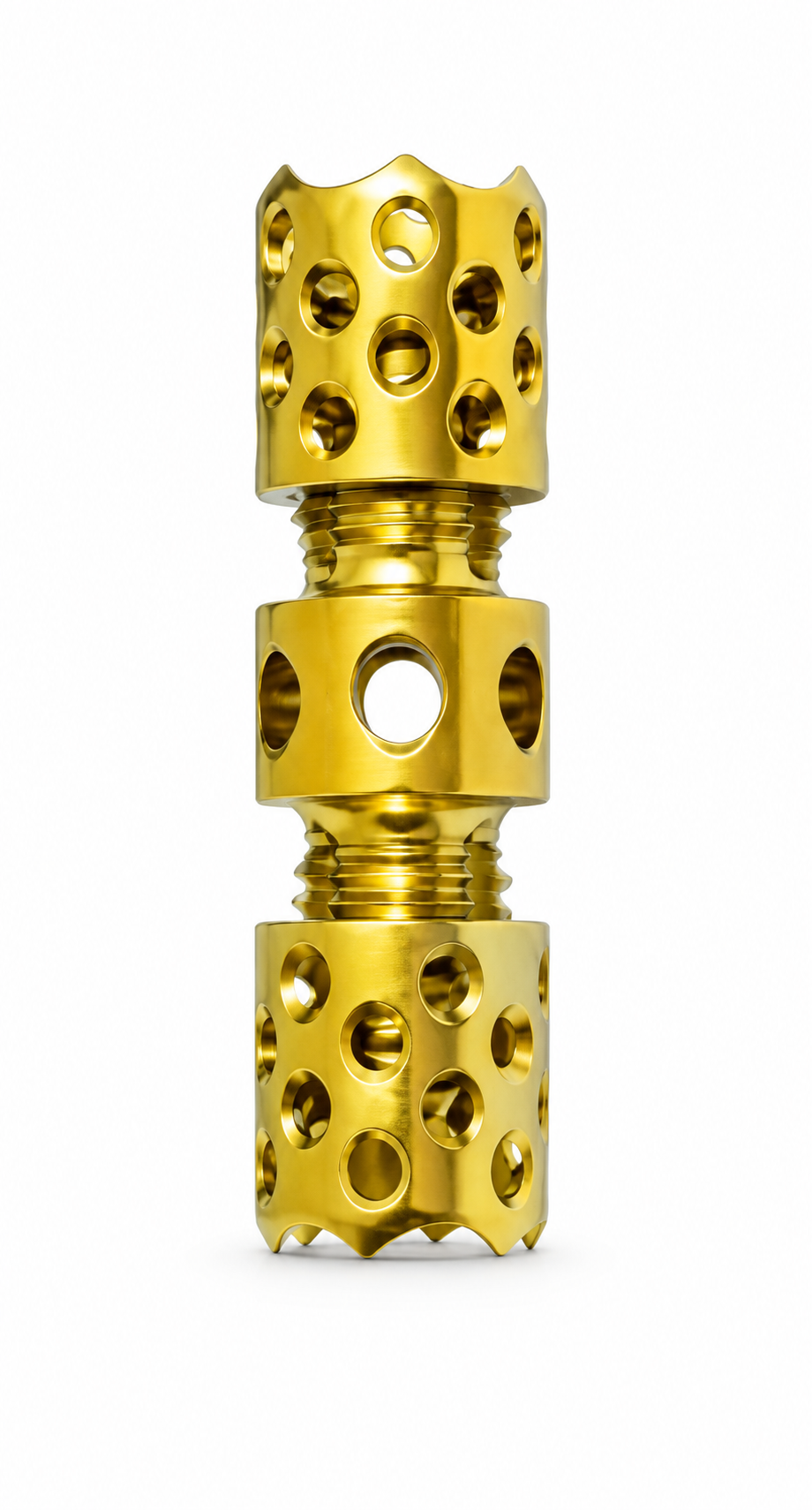
The Telescopic Corpectomy Cage (25 mm) is a titanium spinal reconstruction implant designed for use within compatible corpectomy and vertebral body replacement systems according to the manufacturer’s approved indications and surgical technique.
The implant features an expandable / telescopic multi-section geometry consisting of superior and inferior cage sections connected through a central adjustment mechanism. Multiple openings are incorporated throughout the cage body, forming part of the implant’s structural, vertebral-contact, and reconstruction geometry.
According to the supplied product data, the material is:
Material: Titanium
The product family is listed under:
Cat. No.: AMS 528.235.000
Two dimensional configurations are shown in the supplied catalog:
- 20 × 35 × 65 mm
- 20 × 52 × 72 mm
These configurations provide different implant options for selection according to factors such as vertebral defect dimensions, reconstruction height, spinal anatomy, required cage footprint, adjacent vertebral geometry, and intraoperative assessment.
Each configuration carries a dedicated Cat. No. and GTIN No., supporting accurate implant identification, product traceability, surgical set preparation, procurement, inventory management, and stock control.
Product Explanation
The Telescopic Corpectomy Cage is an expandable spinal implant intended to replace or bridge an appropriate vertebral body defect following a corpectomy procedure, where included within the approved indications.
A simplified reconstruction concept can be represented as:
Superior Vertebral Body → Telescopic Corpectomy Cage → Inferior Vertebral Body → Spinal Reconstruction Construct
The telescopic mechanism provides an adjustable central structure between the superior and inferior cage sections according to the system design.
The supplied data does not specify the exact expansion or distraction range.
Product Components and Design
- Titanium Cage Body
The main structural components are manufactured from Titanium, according to the supplied catalog.
- Telescopic Central Mechanism
The implant incorporates a central telescopic / expandable mechanism connecting the upper and lower cage sections.
The catalog does not specify:
- Expansion range.
- Adjustment increment.
- Maximum distraction.
- Locking mechanism.
- Required adjustment instrument.
- Superior Cage Section
The upper section includes multiple openings and structural features forming part of the vertebral contact interface.
- Inferior Cage Section
The lower section incorporates a similar perforated configuration to form the opposite vertebral interface.
- Multiple Openings
Several apertures are incorporated into the implant body.
These may relate to graft access, visualization, instrumentation, or structural design, depending on the approved system configuration.
- Dimension-Specific Configurations
The supplied catalog lists:
20 × 35 × 65 mm
20 × 52 × 72 mm
with separate product codes and GTIN numbers.
Intended Use
The Telescopic Corpectomy Cage is intended for use within compatible spinal vertebral body reconstruction systems, according to the manufacturer’s approved indications and Instructions for Use.
Potential applications, where included within the approved indications, may include:
- Vertebral body replacement.
- Corpectomy reconstruction.
- Anterior spinal column reconstruction.
- Stabilization following appropriate vertebral body resection.
- Reconstruction of vertebral defects.
- Integration within a compatible spinal stabilization construct.
Selection of the appropriate configuration depends on:
- Spinal anatomy.
- Vertebral defect dimensions.
- Required reconstruction height.
- Implant footprint.
- Adjacent vertebral dimensions.
- Bone quality.
- Endplate contact requirements.
- Preoperative planning.
- Intraoperative assessment.
The implant should be selected and implanted by a qualified spine surgeon according to the approved surgical technique and IFU.
Key Benefits
Titanium Material
The supplied catalog specifies:
Material: Titanium
Telescopic / Expandable Design
The implant features a central adjustable configuration characteristic of an expandable corpectomy cage system.
Vertebral Body Reconstruction Application
Designed for compatible corpectomy and vertebral body replacement constructs.
Two Dimensional Configurations
Available in:
20 × 35 × 65 mm
20 × 52 × 72 mm
providing different reconstruction options.
Multi-Section Cage Geometry
The device integrates:
- Superior cage section.
- Central telescopic mechanism.
- Inferior cage section.
within a single reconstruction implant.
Perforated Structural Design
Multiple openings are incorporated throughout the implant geometry.
Product Traceability
Each configuration has a dedicated Cat. No. and GTIN No. to support:
- Implant identification.
- Product traceability.
- Surgical set preparation.
- Procurement.
- Inventory management.
- Stock control.
Technical Specifications
| Dimensions | Cat. No. | GTIN No. |
| 20 × 35 × 65 mm | AMS 528.235.065T | 6221361043862 |
| 20 × 52 × 72 mm | AMS 528.252.072T | 6221361043879 |
Technical Overview
Product Name: Telescopic Corpectomy Cage (25 mm)
Material: Titanium
Product Type: Expandable / Telescopic Corpectomy Cage
Product Category: Spinal Vertebral Body Replacement Implant
General Cat. No.: AMS 528.235.000
Listed Configurations: 20×35×65 / 20×52×72 mm
Number of Configurations: 2
Design: Multi-Section Telescopic Reconstruction Cage
Functional Role: Vertebral body replacement and spinal reconstruction according to approved indications
Anatomical Application: Spine
Identification: Individual Cat. No. and GTIN No. for each configuration
Product Features
- Telescopic Corpectomy Cage Design.
- Manufactured from Titanium according to the catalog.
- Designed for compatible spinal reconstruction systems.
- Expandable / telescopic central configuration.
- Multi-section cage construction.
- Perforated superior and inferior cage geometry.
- Multiple structural openings incorporated into the implant.
- Available in 2 dimensional configurations.
- Designed for compatible vertebral body replacement constructs.
- Supports intraoperative implant selection according to anatomical and defect dimensions.
- Individual Cat. No. for each configuration.
- Individual GTIN No. for each variant.
- Supports implant identification, product traceability, procurement, and inventory management
Reviews
There are no reviews yet.