
Product Explanation
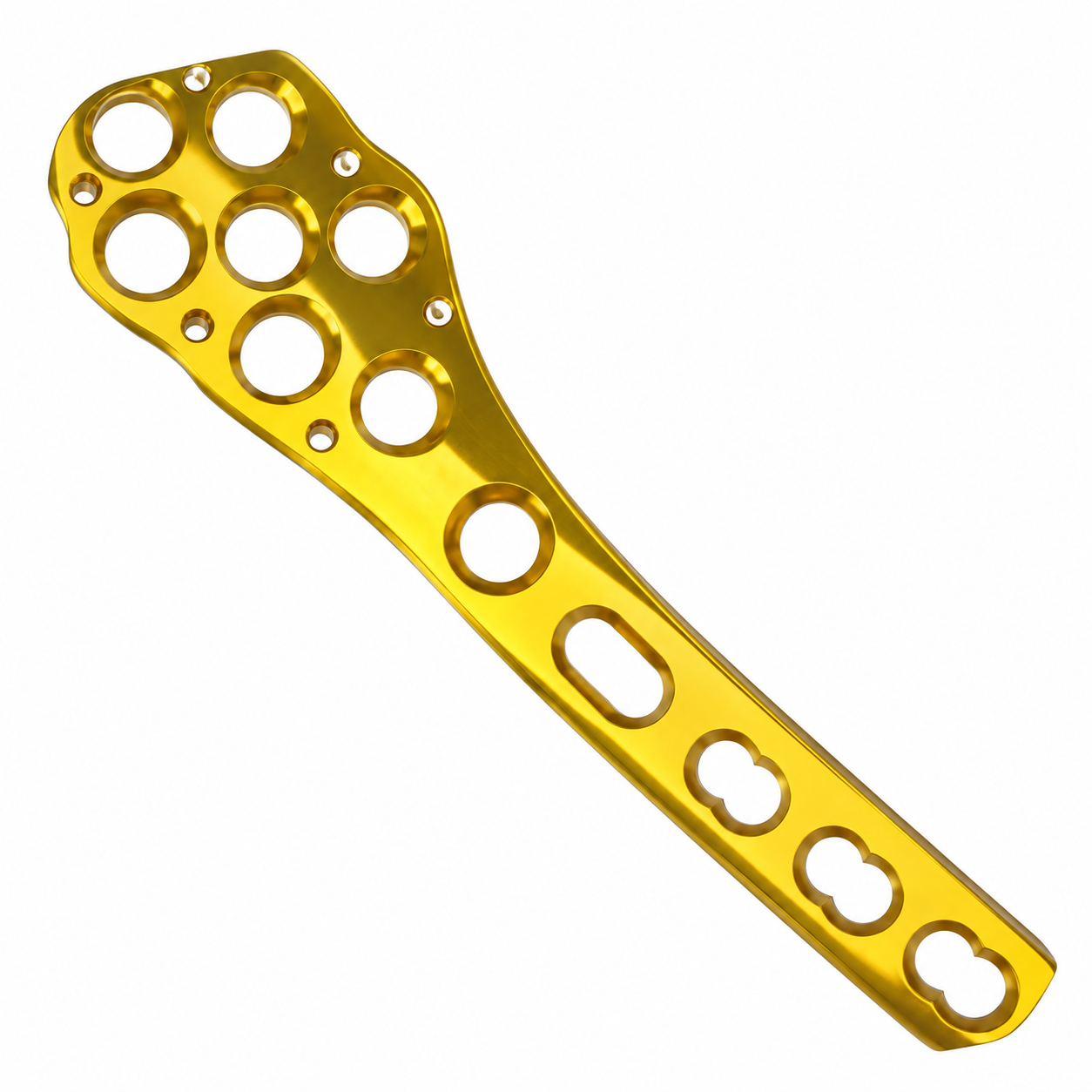
The Locking Posteromedial Proximal Tibial Plate, 3.5 mm is an orthopedic fixation plate intended to form part of a compatible internal fixation construct involving the posteromedial region of the proximal tibia.
A simplified fixation concept can be represented as:
Proximal Tibia → Posteromedial Locking Plate → Compatible Fixation Screws → Internal Fixation Construct
The product is specifically identified as a:
Posteromedial Proximal Tibial Plate
according to the supplied product designation.
The plate is selected and positioned according to proximal tibial anatomy, fracture configuration, required fixation construct, required plate length, surgical plan, approved surgical technique, and Instructions for Use.
According to the supplied product data, the product family includes:
2 / 4 / 6 / 8 / 10 Shaft Holes
providing multiple plate configurations.
No specific Left / Right alignment or numerical head-hole configuration is provided in the supplied image.
Product Components and Design
- Posteromedial Proximal Tibial Plate Body
The implant consists of an elongated metallic fixation plate with a broadened and contoured proximal section connected to a narrower longitudinal shaft.
The product is specifically identified as:
Locking Posteromedial Proximal Tibial Plate
according to the supplied product name.
The exact anatomical contour, proximal width, posteromedial curvature, dimensions, thickness, and plate-to-bone relationship should be confirmed from the manufacturer’s technical drawings.
- Proximal Fixation Section
The proximal portion of the plate is visibly broadened and contains fixation openings.
However, the supplied product data states:
Head Holes: –
Therefore, no official numerical head-hole count is specified.
The exact number, classification, compatible screw type, locking interface, screw angle, and trajectory of the proximal openings should be confirmed from the manufacturer’s technical documentation rather than inferred solely from the image.
- Shaft Section
According to the supplied product information, the plate is available with:
2 Shaft Holes
4 Shaft Holes
6 Shaft Holes
8 Shaft Holes
10 Shaft Holes
This provides five listed shaft-hole configurations within the product family.
The exact physical plate length corresponding to each shaft-hole configuration is not supplied.
- Multiple Fixation Opening Geometries
The supplied product image visually shows several fixation opening geometries along the plate.
These include:
- Proximal fixation openings.
- Circular shaft openings.
- An elongated / contoured opening in the proximal-shaft transition.
- Smaller longitudinal openings along the shaft.
- Multiple fixation positions distributed along the plate body.
The exact technical function of each opening—such as locking fixation, conventional fixation, compression, positioning, or another role—is not specified in the supplied product information and should be confirmed from the approved surgical technique.
- Posteromedial Plate Configuration
The product is specifically designated:
Posteromedial
within the supplied product title.
This indicates a distinct plate configuration within the proximal tibial fixation family.
The exact anatomical surface, plate orientation, contour, and approved surgical positioning associated with the posteromedial configuration should be confirmed from the manufacturer’s surgical technique and technical documentation.
- Contoured Proximal Geometry
The plate features a widened and contoured proximal section rather than a simple straight profile.
The exact proximal bend, offset, posteromedial contour, width, and orientation are not provided in the supplied image.
These characteristics should be obtained from the manufacturer’s dimensional and engineering drawings.
- Alignment
According to the supplied product data:
Alignment: –
No Left / Right or other anatomical alignment is specified.
Therefore, the product should not be described as side-specific based solely on the supplied image.
The availability of side-specific variants should be confirmed from the manufacturer’s official catalog.
- Material Options
According to the supplied product information, the plate is available in:
SS316L
and
Titanium
The exact Titanium alloy or grade is not specified in the supplied image and should be confirmed from the manufacturer’s official material specification.
Intended Use
The Locking Posteromedial Proximal Tibial Plate, 3.5 mm is designed for use as part of a compatible orthopedic fixation system involving the proximal tibia, according to the approved indications, surgical technique, and Instructions for Use.
Potential applications may involve internal fixation of the proximal tibia where a posteromedial plate configuration is included within the manufacturer’s approved indications.
The exact fracture patterns, fracture classifications, anatomical indications, fixation strategy, surgical approach, contraindications, and patient-selection criteria should be confirmed from the official product documentation.
Plate selection may depend on factors including:
- Proximal tibial anatomy.
- Posteromedial anatomical location.
- Fracture location and configuration.
- Required posteromedial fixation pattern.
- Required fixation construct.
- Required shaft-hole configuration.
- Required plate length.
- Bone dimensions.
- Bone quality.
- Compatible screw selection.
- Proximal screw trajectory requirements.
- Compatible instrumentation.
- Surgical approach.
- Preoperative planning.
- Intraoperative assessment.
The implant should be selected and implanted by a qualified orthopedic surgeon in accordance with the approved surgical technique and Instructions for Use.
Key Benefits
Posteromedial Proximal Tibial Configuration
The product is specifically identified as a:
Locking Posteromedial Proximal Tibial Plate
providing a dedicated posteromedial configuration within a compatible proximal tibial fixation system.
The exact anatomical and biomechanical role of this configuration should be confirmed from the manufacturer’s approved documentation.
Five Shaft-Hole Configurations
The product family includes:
2 / 4 / 6 / 8 / 10 Shaft Holes
providing five different plate configurations.
This supports selection among multiple plate variants according to fixation requirements and surgical planning.
3.5 mm Fixation System
The product is identified as:
Locking Posteromedial Proximal Tibial Plate, 3.5 mm
indicating its association with a compatible 3.5 mm orthopedic fixation system.
The exact compatible screw types and whether every visible opening accepts a 3.5 mm screw should be confirmed from the manufacturer’s system documentation.
Two Material Options
According to the supplied product information, the plate is available in:
SS316L
and
Titanium
Multiple Plate-Length Configurations
The available shaft-hole options:
2 → 4 → 6 → 8 → 10
indicate multiple plate variants within the same product family.
The corresponding physical plate lengths are not supplied and should be confirmed from the manufacturer’s dimensional specifications.
Multiple Product Variants
Based strictly on the supplied product information, the family includes:
- Alignment: Not specified
- Head-hole configuration: Not specified
- 5 shaft-hole options: 2 / 4 / 6 / 8 / 10
- 2 material options: SS316L / Titanium
If every shaft-hole configuration is available in both materials, this could represent up to 10 basic shaft × material combinations.
The exact number of commercially available variants should be confirmed from the official Cat. No. table.
Technical Specifications
| Specification | Product Data |
| Product Name | Locking Posteromedial Proximal Tibial Plate, 3.5 mm |
| Product Category | Trauma – Tibia |
| Product Type | Locking Orthopedic Fixation Plate |
| Plate Configuration | Posteromedial Proximal Tibial Plate |
| Anatomical Region | Proximal Tibia – Posteromedial |
| System Size | 3.5 mm |
| Alignment | Not specified |
| Head Holes | Not specified |
| Shaft Hole Options | 2, 4, 6, 8, 10 |
| Number of Shaft-Hole Options | 5 |
| Materials | SS316L, Titanium |
| Potential Basic Configurations | Up to 10, subject to catalog confirmation |
| Cat. No. | Not provided |
| GTIN No. | Not provided |
| Plate Lengths | Not provided |
| Proximal Plate Width | Not provided |
| Plate Thickness | Not provided |
| Posteromedial Contour / Bend Geometry | Not provided |
| Compatible Screw Details | Not provided |
| Screw Trajectories | Not provided |
| Titanium Grade | Not provided |
| Compatible Instrumentation | Not provided |
Technical Overview
Product Name: Locking Posteromedial Proximal Tibial Plate, 3.5 mm
Product Category: Trauma – Tibia
Product Type: Locking Orthopedic Fixation Plate
Plate Type: Posteromedial Proximal Tibial Plate
Anatomical Region: Proximal Tibia – Posteromedial
System: 3.5 mm
Alignment: Not specified
Head Holes: Not specified
Shaft Hole Options: 2, 4, 6, 8, and 10
Material Options: SS316L and Titanium
Plate Geometry: Contoured proximal fixation region with elongated shaft
Fixation Concept: Plate-and-screw internal fixation using a compatible orthopedic fixation system
Side-Specific Design: Not specified
Configuration: Posteromedial Proximal Tibial
Cat. No.: Not supplied
GTIN No.: Not supplied
Plate Lengths: Not supplied
Plate Thickness: Not supplied
Specific Titanium Grade: Not supplied
Specific Screw Compatibility: Not supplied
Product Features
- Locking orthopedic fixation plate design.
- Specifically identified as a Posteromedial Proximal Tibial Plate.
- Associated with a 3.5 mm fixation system.
- Alignment is not specified in the supplied product data.
- No numerical head-hole count is specified.
- Available with 2 shaft holes.
- Available with 4 shaft holes.
- Available with 6 shaft holes.
- Available with 8 shaft holes.
- Available with 10 shaft holes.
- Provides five shaft-hole configurations.
- Available in SS316L.
- Available in Titanium.
- Features a contoured proximal fixation region.
- Features an elongated longitudinal shaft.
- Includes visible proximal fixation openings.
- Includes circular and elongated / contoured openings.
- Supports multiple potential plate-length configurations.
- Exact posteromedial anatomical contour should be confirmed from official technical documentation.
- Exact proximal head-hole count and classification should be confirmed from the manufacturer’s technical drawings.
- Exact compatible screw types and diameters should be confirmed from the product system documentation.
- Exact proximal screw trajectories and locking characteristics should be confirmed from approved technical drawings.
- Exact plate lengths, proximal contour, width, and thickness should be confirmed from the manufacturer’s dimensional specifications.
- Individual Cat. No. and GTIN No. should be added when the official product table is available.
- Approved indications, contraindications, and surgical technique should be confirmed from the manufacturer’s Instructions for Use (IFU).
![Cancellous Screw 6.5 MM Partially Threaded [TIT]](https://amseo-group.com/wp-content/uploads/2026/09/Cancellous-Screw-6.5-MM-Partially-Threaded-TIT-300x300.png)
Reviews
There are no reviews yet.