
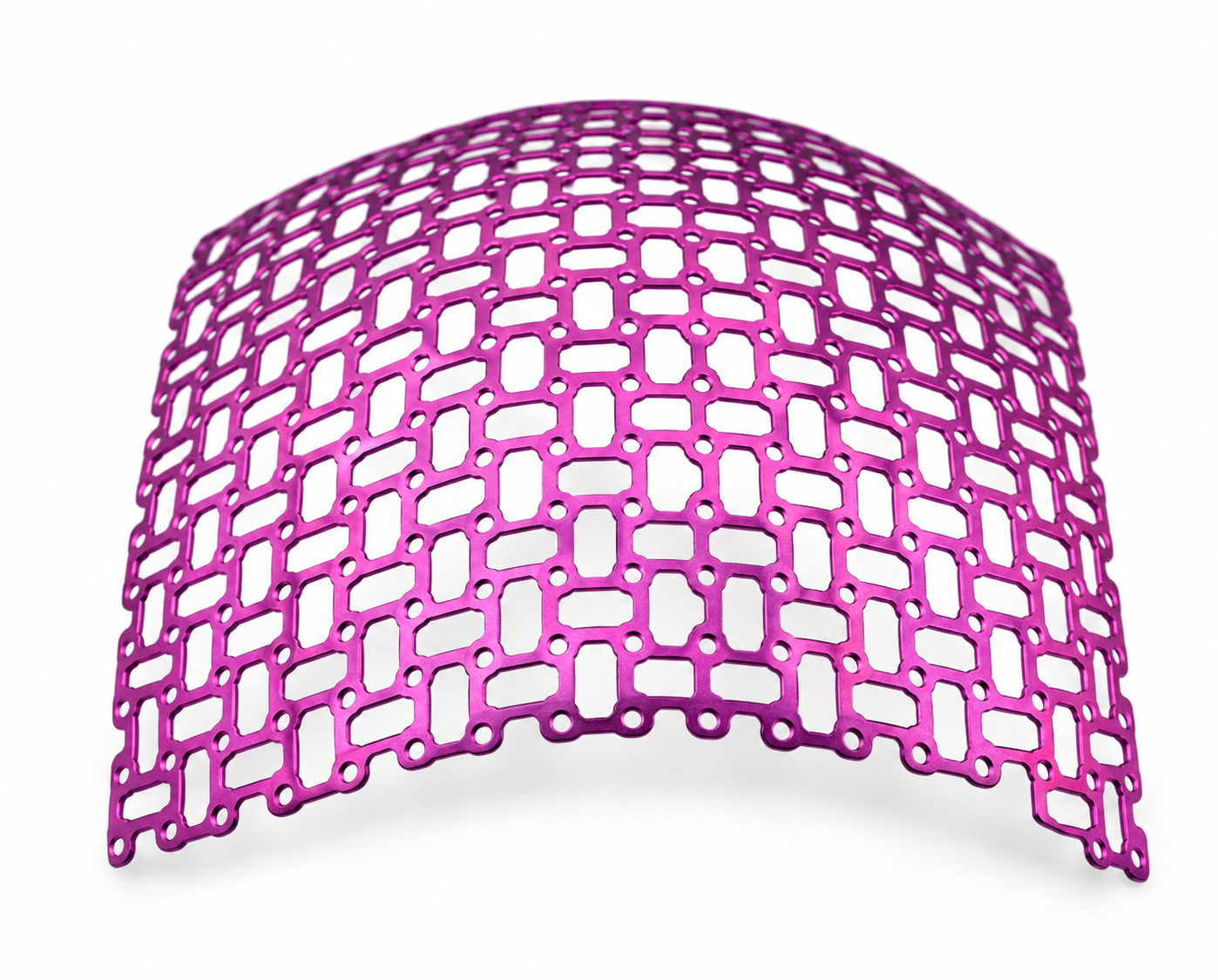
The Cranial Mesh is a titanium cranial reconstruction implant designed for use within compatible cranial fixation and reconstruction systems according to the manufacturer’s approved indications and surgical technique.
The implant features a thin perforated mesh structure containing multiple regularly distributed openings across its surface. This geometry allows the mesh to form part of a cranial reconstruction construct and provides multiple potential fixation locations when used with compatible cranial screws and related fixation components.
According to the supplied catalog information, the implant is manufactured from:
Material: Titanium
The product family is listed under:
Cat. No.: AMS 518.006.000
The catalog provides two dimensional configurations:
- 0.6 × 100 × 100 mm
- 0.6 × 100 × 200 mm
Both variants share the listed 0.6 mm thickness, while providing different overall surface dimensions for implant selection according to cranial defect dimensions, required coverage, contouring requirements, fixation layout, and intraoperative assessment.
Each configuration carries an individual Cat. No. and GTIN No., supporting accurate implant identification, product traceability, surgical set preparation, procurement, inventory management, and stock control.
Product Explanation
The Cranial Mesh is a thin metallic implant designed to form part of a compatible cranial reconstruction construct.
A simplified fixation concept can be represented as:
Cranial Bone → Cranial Mesh → Compatible Cranial Screws → Cranial Reconstruction Construct
The mesh can be positioned over or across an appropriate cranial defect according to the approved surgical technique, while its perforated structure provides multiple potential fixation points for compatible screws.
Product Components and Design
- Titanium Mesh Body
The primary implant structure is manufactured from Titanium, according to the supplied catalog data.
The mesh body forms the main reconstruction surface.
- Perforated Mesh Geometry
The implant contains multiple regularly distributed openings throughout the mesh.
This perforated geometry forms a key part of the implant design.
The supplied data does not specify:
- Individual aperture dimensions
- Hole spacing
- Open-area percentage
- Mesh strand width
- 0.6 MM Thickness
Both listed product configurations specify:
Thickness: 0.6 mm
according to the dimensions provided in the catalog.
- Contourable Sheet Configuration
The product image shows a thin mesh sheet presented in a curved form.
The exact contouring limits, bending recommendations, and trimming technique should be confirmed from the official surgical technique and IFU.
- Two Surface Dimensions
Available configurations are:
- 0.6 × 100 × 100 mm
- 0.6 × 100 × 200 mm
providing two coverage options within the product family.
Intended Use
The Cranial Mesh is intended for use within compatible cranial reconstruction and fixation systems, according to the manufacturer’s approved indications and Instructions for Use.
Potential applications, where included within the approved indications, may include:
- Cranial defect reconstruction.
- Cranioplasty-related reconstruction.
- Cranial mesh fixation constructs.
- Coverage of appropriate cranial defects.
- Integration with compatible cranial screws and fixation components.
- Craniofacial reconstruction where specifically approved by the manufacturer.
Selection of the appropriate mesh configuration depends on:
- Cranial defect dimensions.
- Required reconstruction area.
- Anatomical contour.
- Fixation point distribution.
- Bone quality.
- Required mesh coverage.
- Preoperative planning.
- Intraoperative assessment.
The implant should be selected and implanted by an appropriately qualified cranial, neurosurgical, or maxillofacial specialist, as applicable, according to the approved surgical technique and IFU.
Key Benefits
Titanium Material
The supplied catalog specifies:
Material: Titanium
Thin 0.6 MM Mesh Design
Both configurations use a listed thickness of:
0.6 mm
Perforated Reconstruction Geometry
The implant incorporates multiple openings across the mesh surface, providing a multi-point fixation geometry for compatible cranial constructs.
Two Coverage Options
Available configurations include:
100 × 100 mm
and
100 × 200 mm
with the same listed 0.6 mm thickness.
Large-Area Mesh Format
The two sheet dimensions provide different surface coverage options for cranial reconstruction planning.
Compatible Screw Integration
The perforated geometry supports integration with compatible cranial fixation screws according to the system design.
Product Traceability
Each configuration has an individual Cat. No. and GTIN No. to support:
- Implant identification.
- Product traceability.
- Surgical set preparation.
- Procurement.
- Inventory management.
- Stock control.
Technical Specifications
| Dimensions | Cat. No. | GTIN No. |
| 0.6 × 100 × 100 mm | AMS 518.006.010T | 6221361019522 |
| 0.6 × 100 × 200 mm | AMS 518.006.020T | 6221361019553 |
Technical Overview
Product Name: Cranial Mesh
Material: Titanium
Product Type: Cranial Reconstruction Mesh
Product Category: Cranial Internal Fixation / Reconstruction Implant
General Cat. No.: AMS 518.006.000
Listed Thickness: 0.6 mm
Available Dimensions: 0.6×100×100 / 0.6×100×200 mm
Number of Configurations: 2
Design: Perforated Titanium Mesh Sheet
Fixation Concept: Mesh-to-Bone Cranial Fixation with compatible components
Anatomical Application: Cranial Region
Identification: Individual Cat. No. and GTIN No. for each configuration
Product Features
- Titanium Cranial Mesh Design.
- Manufactured from Titanium according to the catalog.
- Designed for compatible cranial reconstruction systems.
- Perforated mesh geometry.
- Listed thickness: 0.6 mm.
- Available in 2 dimensional configurations.
- Dimensions: 100×100 mm and 100×200 mm at 0.6 mm thickness.
- Provides multiple potential fixation locations across the mesh surface.
- Supports different cranial coverage requirements.
- Designed for integration with compatible cranial screws and fixation components.
- Individual Cat. No. for each configuration.
- Individual GTIN No. for each variant.
- Supports implant identification, traceability, procurement, and inventory management.
Reviews
There are no reviews yet.